
Routster Studio
Forking and following
Compares the variations of every forked course, so that no runner gets the easy fork by luck and runners do not simply follow each other.
What it does
For every forked course it measures each variation the way the winning time module measures a course, as metres of flat white forest along the best routes with the ground and the climb they cross, and compares them. A variation that costs more than the easiest by more than the share you set is flagged, with the figure, as worth evening out.
It also looks at following. It tells you how many legs the variations run together from the start, so you can see whether anything splits the runners before that, and it finds the places where two variations run the same legs in a row, so that runners on different variations can follow each other.
Courses that are not forked but run at the same time, such as two classes starting close together, can be ticked and compared the same way.
How you use it
- Make the forks with the course's own variations, as you always do.
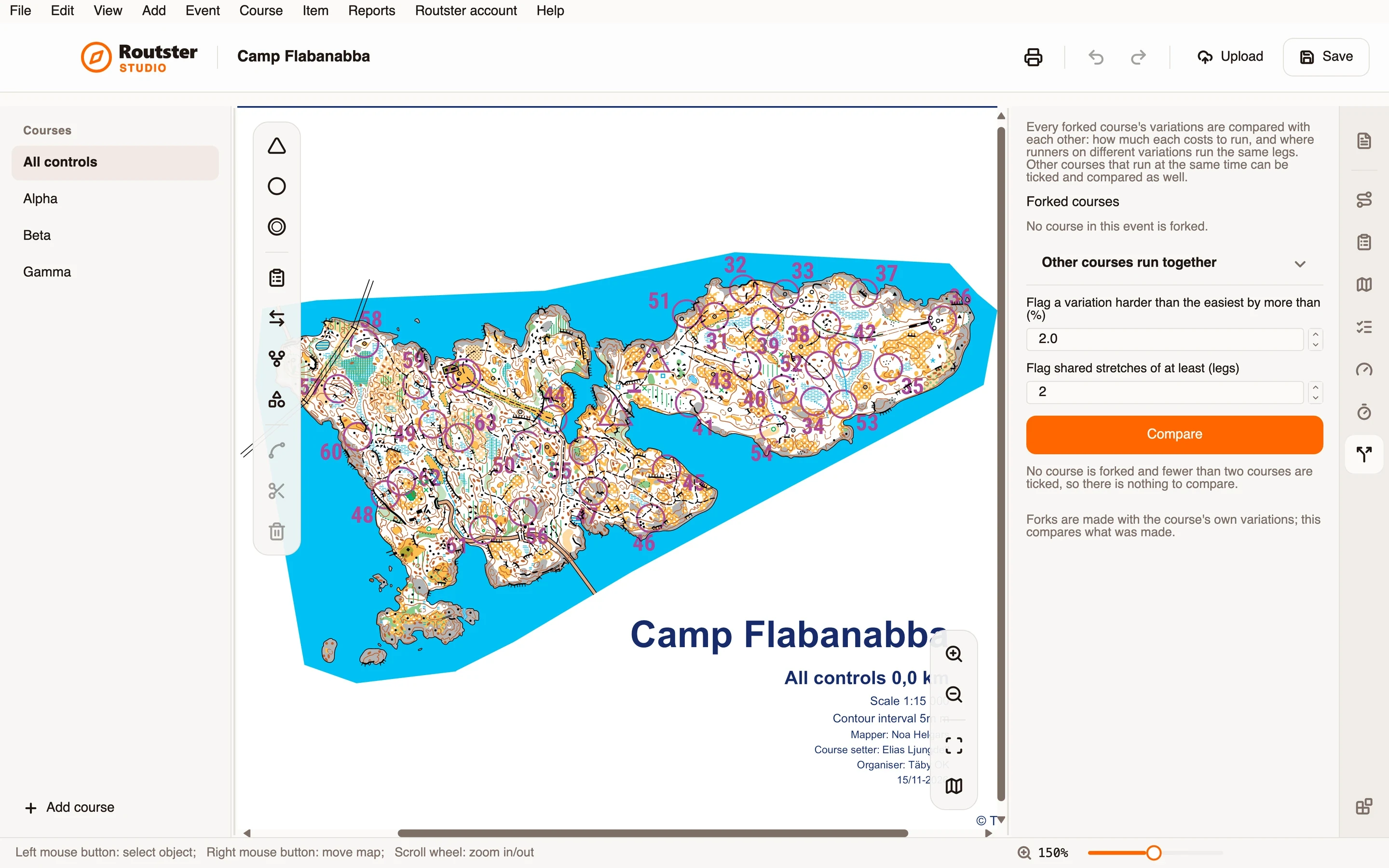
- Open the module's page. The forked courses are listed with their number of variations.
- Tick other courses that run at the same time, if you want them compared too.
- Set how much harder a variation may be than the easiest before it is flagged, and how many legs a shared stretch must be to count.
- Press Compare.
- Read the result for each group, and even out what is flagged.
What it needs, and what it does not do
- It compares what you made. It does not make forks.
- It runs when you ask. It needs the map's scale to measure in metres, and without it nothing is compared.
- If not every variation could be routed, it falls back to straight lines from control to control, says so, and warns that a fork round an obstacle then looks fairer than it is.
- It gives no running totals of climb. Its measure of effort already includes the climb along the routes.